
How much wax and fragrance oil do you need for a batch?
Updated
On this page7
Multiply the number of candles by the measured weight of one finished candle, add what your pitcher keeps behind, then split that total into wax and oil using your fragrance load. If the load is a percent of the wax, the wax is the total divided by one plus the load, and the oil is the rest. Twelve candles that each weigh 200 g at 6.25 percent of the wax need 2,258.8 g of wax and 141.2 g of oil. Enter your jar count, your fill weight from a test pour and your load, and the calculator returns both weights in grams, ounces and pounds, with a warning if you pass a limit you enter.
Three numbers to have before you use it
The calculator is only as good as what you type in. Each input has a home where it is measured or explained.
- The fill weight of one candle. This is the net weight of one finished candle at your fill line: wax plus fragrance plus dye, weighed after it sets, less the empty jar and wick. Find it by pouring three jars and averaging them, as how full to fill a candle jar explains. A jar's capacity in fluid ounces will not do. Capacity is a volume, the wax weighs less than water, and nobody fills to the brim, so a "9 oz" jar does not hold 9 oz of candle.
- Your fragrance load and what it is a percent of. Most suppliers state loads as a percent of the wax weight. CandleScience, for example, lists SimplySoy's container maximum as "10% or 1.6 oz/lb. (45 g/454 g)" [1], and 1.6 oz is 10 percent of the 16 oz in a pound, so that figure is a percent of the wax. Some recipes give a percent of the finished candle. The calculator asks which you mean. If you are not sure, how much fragrance oil to use shows how to tell.
- What your pitcher keeps. Some scented wax always stays on the wall and spout. Weigh your pitcher before and after one full pour to learn the figure, then enter it here. It belongs to your pitcher, your wax and your pouring speed, so no published number applies to you.
What the calculator does with them
It adds up the candle weight you need, then splits it.
- Total to make = number of candles × fill weight + pitcher residue.
- Load as a percent of wax: wax = total ÷ (1 + load), and oil = total − wax. A load of 6.25 percent goes in as 0.0625.
- Load as a percent of the candle: oil = total × load, and wax = total − oil.
Either way it then reports the load both ways, plus ounces of oil per pound of wax, so you can check the result against a data sheet written in either form. The arithmetic is the same as on choosing a batch size and how much fragrance oil to use; this page just does it for any jar.
A worked batch: eighteen tumblers of soy
Suppose your test pours show one finished candle weighs 200 g (an illustrative figure; use your own), you are making 18, your pitcher keeps 20 g, and you are following the CandleScience soy tutorial's proportion of 1 oz of oil to 1 lb of wax [2]. Measured exactly, 1 oz in 16 oz of wax is 6.25 percent of the wax weight and 5.9 percent of the finished candle; the tutorial calls it "approximately a 7% fragrance load" [2], and how much fragrance oil to use explains the difference.
| Step | Arithmetic | Result |
|---|---|---|
| Candle weight needed | 18 × 200 g | 3,600 g |
| Add pitcher residue | 3,600 + 20 | 3,620 g |
| Wax | 3,620 ÷ 1.0625 | 3,407.1 g (7.51 lb) |
| Fragrance oil | 3,620 − 3,407.1 | 212.9 g (7.51 oz) |
| Check: oil as percent of candle | 212.9 ÷ 3,620 | 5.88 percent |
| Check: ounces per pound of wax | 6.25 × 16 ÷ 100 | 1.00 oz/lb |
Two things to read from the table. The oil in ounces and the wax in pounds come out as the same number, 7.51, which is what 1 oz per lb means. And 7.51 lb of wax fits in one 10 lb bag of SimplySoy, a size CandleScience sells [1], with enough left for a few spare candles.
Spares and test candles
Add any test candles to the count rather than guessing a margin. If you want two candles from the batch kept back as retained samples, enter 20 instead of 18. A retained sample is a candle you keep from a batch so you can burn it later if a customer reports a problem.
The warnings, and which limit wins
You can enter up to two limits, and the calculator compares the batch with each.
| Limit | What to enter | How the calculator compares it |
|---|---|---|
| Your wax's maximum load | The figure from your wax's data sheet, and whether it is a percent of wax or of candle | Against the batch load on the same basis |
| Your oil's IFRA maximum for candles | The figure on the oil's IFRA certificate | Against the oil as a percent of the finished candle, because IFRA states its limits as a concentration "in the finished consumer product" [3] |
When a sheet gives a bare percentage, such as the Golden Brands GW 464 instructions' "Recommended maximum scent load is about 7-9%" [4], it does not say what the percent is of. Enter it as a percent of the candle. That reading gives you less oil, so it keeps you inside the limit whichever basis the sheet meant.
The oil's supplier may also print a usage range. CandleScience lists its Very Vanilla oil at "Candle Safe usage: 3.0% - 10.0%" and says to see the IFRA certificate for maximum levels [5]. The lowest of the wax limit, the oil's range and the IFRA figure is the one that governs. How to read the certificate is on IFRA certificates and fragrance limits.
Treat a warning as a stop sign for the arithmetic: the batch is outside a published limit, so recheck the load before you weigh anything.
What the calculator cannot tell you
- Whether the candle will burn well. A change in load can change the wick you need. CandleScience states that its wick recommendations "are based on a 7.5% fragrance oil load and no dyes" [6]. Burn test every change (what has to be retested).
- Dye. Dye rates are given per pound of wax by each dye maker, in drops, blocks or grams, and they differ by product. Voyageur, for its liquid dye, says to measure by weight [7]. Work out the dye from the wax weight the calculator gives you, using your dye's own instructions (dyeing candles).
- How big a batch your pot holds, or how long you can keep it at pour temperature. Those limits are set out on choosing a batch size.
Before you weigh the first gram
With the weights in hand, the next job is getting them onto the scale accurately, including the small amounts of oil where a gram matters. Weighing wax and fragrance covers scale resolution, taring and the percentage mistake most new makers make once. Record the planned and actual weights on the batch record template.
| Finished candle total | 2400.0 g (84.66 oz) |
|---|---|
| Wax | 2258.8 g (4.98 lb) |
| Fragrance oil | 141.2 g (4.98 oz) |
| Percent of the wax | 6.25% |
| Percent of the candle | 5.88% |
| Ounces per pound of wax | 1.00 |
Top picks
Top containers for candles 4 oz · 58-400 · Glass · Amber · 2.6 in
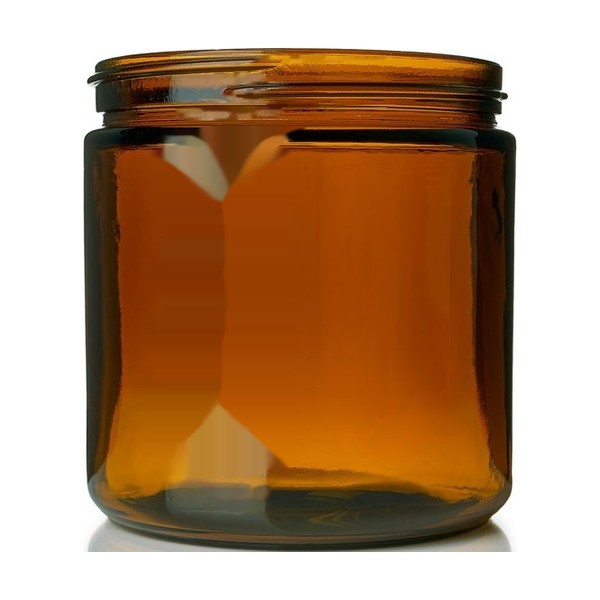 16 oz · 89-400 · Glass
 9 oz · 70-400 · Glass
 4 oz · 58-400 · Glass · Clear
 4 oz · 58-400 · Glass · Amber · 2.7 in
 6 oz · 63-400 · Glass
 4 oz · Steel
 12 oz · 63-400 · Glass
References
- CandleScience, CandleScience SimplySoy Artisan Wax (product page with instructions, applications and bag sizes), undated, read October 22, 2026. https://www.candlescience.com/wax/candlescience-simplysoy-artisan-wax
- CandleScience, How to Make a Soy Candle, updated October 27, 2025. https://www.candlescience.com/learning/how-to-make-a-soy-candle
- IFRA, Understanding the Standards, undated (copyright 2026), read October 22, 2026. https://ifrafragrance.org/understanding-standards
- Voyageur Soap & Candle, Golden Brands GW 464 Soy Container Candle Wax (product page with manufacturer's instructions), undated, read October 22, 2026. https://www.voyageursoapandcandle.com/Golden_Brands_464_Soy_Wax_p/20264.htm
- CandleScience, Very Vanilla Fragrance Oil (product page), undated, read October 22, 2026. https://www.candlescience.com/fragrance/very-vanilla-fragrance-oil-v1/
- CandleScience, Candle Wick (category page with wick guide notes), undated, read October 22, 2026. https://www.candlescience.com/candle-wick
- Voyageur Soap & Candle, Liquid Candle Dye: Wedgewood (product page with usage instructions), read October 22, 2026. https://www.voyageursoapandcandle.com/products/liquid-candle-dye-wedgewood
- 16 CFR 500.8, Units of weight or mass and measure (Legal Information Institute, Cornell Law School), read October 22, 2026. https://www.law.cornell.edu/cfr/text/16/500.8