
Why are there white crystals on my soy candle?
Updated
On this page7
The white, chalky film or feathery crystals on a soy candle are frosting: crystals of the wax itself growing on the surface. Soy wax is made from vegetable fat, and fats can crystallize in more than one form. They tend to set first in less stable forms and shift over time, and faster with warming and cooling, into a more stable form, and that shift shows on the surface as frosting. Paraffin does not do this, which is why frosting is a vegetable wax problem. This page explains the chemistry, what reduces it, which waxes resist it, and how to live with the rest. None of the sources cited here says frosting changes how a candle burns.
What the crystals are
Soy container wax is hydrogenated soybean oil, a fat made mostly of triglycerides (also called triacylglycerols): three fatty acids joined to a glycerol backbone (the soy wax page explains how it is made). Fats like this are polymorphic, meaning the same molecules can pack into more than one crystal form. Food scientists name the main forms alpha, beta prime and beta. A 2020 study in the peer-reviewed journal Molecules describes saturated triglycerides crystallizing first as "the unstable polymorphs, the α or β' forms," which then "transformed into β forms" through solid to solid change, with further heat treatment pushing the change along [1]. Beta is the most stable of the three, and the patent below describes the stable forms as higher melting and denser.
Candle wax patents describe the same thing in candle terms. A patent assigned to Elevance Renewable Sciences (US 8,940,090, granted January 27, 2015) explains that triglycerides "exhibit well-documented polymorphic behavior where as the aliphatic hydrocarbons of paraffin does not," and that under rapid cooling "less stable lower melting less dense crystals form initially," which over time and heat cycles rearrange into "more stable and more dense crystal forms." That rearrangement, it says, "can lead to the problems of cracking and blooming in candle produced from vegetable wax" [2]. Bloom is the industry word for frosting. Another patent, for compression molded candles (US 8,652,221), describes fat bloom as "a white film" that "appears on the surface of the wax article over time" and says it "can also be accelerated by thermal cycling" [3].
Suppliers say the same in fewer words. CandleScience calls frosting "a byproduct of a natural wax," caused by "the growth of tiny crystals on the surfaces of the wax" [4]. Village Craft & Candle names polymorphism and puts it down mainly to temperature fluctuations and time [5].
Why some candles frost and others do not
Two things in the description above set how much you see.
How the wax set. Fast cooling locks in more of the unstable forms, which then have further to go. The GW 464 sheet says "cooling too quickly or too slowly can cause concaving and/or frosting" [6], so the aim is the cooling the wax maker specifies rather than the slowest possible.
What happens after. Every swing between warm and cool gives the molecules a chance to rearrange. A candle that sits in a warm shop window by day and a cold stockroom by night will frost more than one kept at a steady temperature. That is also why a candle can be clean on the day it is poured and frosted a month later.
What reduces frosting
| What to change | What the source says | Source |
|---|---|---|
| Stirring | Mix melted wax less vigorously; over-agitation speeds crystal formation | CandleScience [4]; Village Craft & Candle says to mix slowly after adding fragrance or dye [5] |
| Pour temperature | Pour at a lower temperature, adjusting in 5°F steps | CandleScience [4]. Stay inside your wax's published pour range (pouring temperature and technique) |
| Jar temperature | Preheat glassware in a warm oven on its lowest setting, keeping containers at or below 100°F | CandleScience [4]. The GW 464 sheet says no preheating is necessary for that wax [6] |
| Cooling | Cool at room temperature, ideally 70 to 76°F, away from drafts, preferably on a wire rack | CandleScience [4]. GW 464's maker gives 70°F (21.1°C) [6] |
| Storage | Keep finished candles at a steady temperature | Follows from the thermal cycling described in the patent literature [3]; storage practice is on storing wax, fragrance and finished candles |
| The wax | Use a harder wax or one with a higher melt point | Supplies for Candles [7] |
The patents add a further lever, one that belongs to the wax maker. The Elevance patent says that building glycerol-based compositions into the wax "can stabilize the fat morphology, thereby limiting the transition of the fat from one crystal form to another," and reports a modified wax "free of bloom and cracks," where plain hydrogenated soybean oil bloomed severely [2]. The compression candle patent lists "fat bloom inhibitors" that "retard polymorphic transformation," including monoglycerides, diglycerides, sorbitan esters, polyglycerol polyricinoleate, lecithin, and paraffin "at high levels of incorporation" [3]. These describe how wax makers formulate; neither patent gives a rate for a maker to add to a finished wax. No additive maker's sheet cited here gives a frosting additive rate, so this page gives none (candle wax additives).
Waxes sold as frost resistant
Several container waxes are formulated against frosting, and the makers say so:
- Golden Brands GW 464: "highly frost resistant," per the manufacturer's instructions on Voyageur's page [6].
- CandleScience SimplySoy: its additives "reduce frosting and enhance fragrance throw" [8].
- CandleScience coconut apricot: "formulated to be highly resistant to frosting," with "no signs of frosting" in CandleScience's test candles. It is a blend of soy, coconut, apricot and paraffin [9].
These are the makers' statements about their own products. Read "frost resistant" as less frosting under the maker's conditions, which still leaves room for some in a cold or changeable room. Blends that include paraffin fit the patent description above, since paraffin does not change crystal form. If you sell a blend, describe it truthfully (coconut wax and wax blends).
Living with what is left
Frosting on pure soy is hard to remove entirely. Two options work around it:
- Hide it. Village Craft & Candle suggests frosted, dark colored or opaque containers [5]. Frosting shows most on dyed wax in clear glass; it also suggests leaving candles their natural color [5].
- Smooth the top. A heat gun pass melts frosting off the top surface for a while, the same way it smooths a rough top (see sinkholes, cracks and rough tops). It will usually come back with time and temperature changes, for the reasons above.
Frosting on the side of the jar, and the patches that are not frosting
White frosting can form where wax meets glass, and it is easy to confuse with pull-away. Frosting is white and crystalline; a wet spot is a clear or darker patch where the wax has left the glass. The second is covered on wet spots on glass candles.
Top picks
Top containers for candles 4 oz · 58-400 · Glass · Amber · 2.6 in
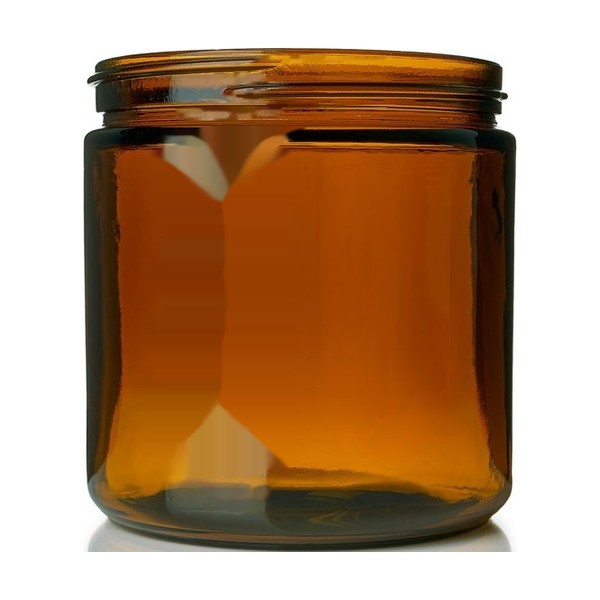 16 oz · 89-400 · Glass
 9 oz · 70-400 · Glass
 4 oz · 58-400 · Glass · Clear
 4 oz · 58-400 · Glass · Amber · 2.7 in
 6 oz · 63-400 · Glass
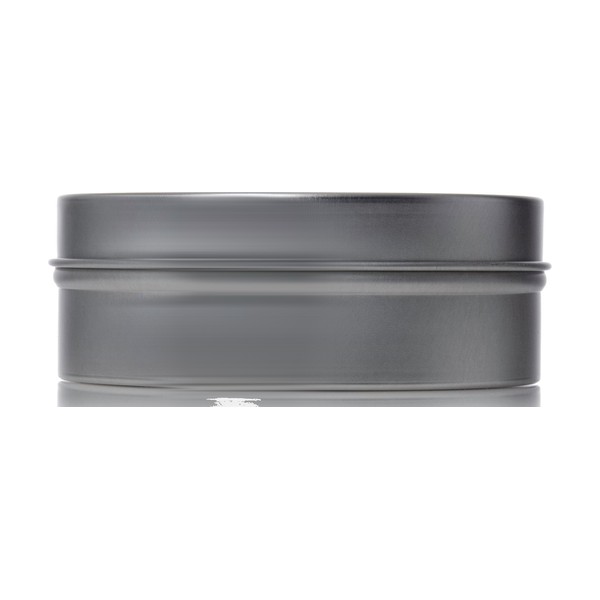 4 oz · Steel
 12 oz · 63-400 · Glass
References
- Seiya Takeguchi, Arisa Sato, Hironori Hondoh, Mio Aoki, Hidetaka Uehara and Satoru Ueno, Multiple β Forms of Saturated Monoacid Triacylglycerol Crystals, Molecules 25(21):5086, November 2020 (DOAJ record). https://doaj.org/article/b86189ddc2e1439da615d21078bcbe71
- Daniel Wayne Lemke and Michael C. Thiede (Elevance Renewable Sciences, Inc.), Wax compositions and methods of preparing wax compositions, U.S. Patent 8,940,090, filed October 31, 2013, granted January 27, 2015 (Justia Patents). https://patents.justia.com/patent/8940090
- Hybrid wax compositions for use in compression molded wax articles such as candles, U.S. Patent 8,652,221, full text (USPTO), read October 22, 2026. https://image-ppubs.uspto.gov/dirsearch-public/print/downloadPdf/8652221
- CandleScience, Soy Wax Troubleshooting Guide, undated (images dated 2021), read October 22, 2026. https://www.candlescience.com/wax/soy-wax-trouble-shooting-guide/
- Village Craft & Candle (Erin Parsons), Top 10 Candle Making Problems and How to Solve Them, February 8, 2022. https://villagecraftandcandle.com/blogs/news/top-10-candle-making-problems-and-how-to-solve-them
- Voyageur Soap & Candle, Golden Brands 464 Soy Wax (product page with manufacturer's instructions), undated, read October 22, 2026. https://www.voyageursoapandcandle.com/Golden_Brands_464_Soy_Wax_p/20264.htm
- Supplies for Candles, Candle Troubleshooting Guide, undated, read October 22, 2026. https://www.suppliesforcandles.co.uk/?p=9912
- CandleScience, CandleScience SimplySoy Artisan Wax (product page), read October 22, 2026. https://www.candlescience.com/wax/candlescience-simplysoy-artisan-wax
- CandleScience, Lab Notes: CandleScience Coconut Apricot Wax, undated (images dated April 2024), read October 22, 2026. https://candlescience.com/lab-notes-candlescience-coconut-apricot-wax