How hot is too hot for a candle jar, and how do you measure it?
Updated
On this page6
The clearest published numeric limit for candle container temperature is in Kohl's burn test protocol for the candles it buys: the outside surface must stay at or below 175°F (79°C) for glass or ceramic and 140°F (60°C) for metal while the candle burns. Those are one retailer's buyer requirements, with no legal force and separate from the ASTM text. They are still a sound target for any container candle. This page covers which thermometer gives a true reading on glass and on shiny tins, where and when to take the reading so you catch the hottest point, and what a hot jar says about the wick.
The limits, and where they come from
| Container | Kohl's maximum external surface temperature [1] |
|---|---|
| Glass | 175°F (79°C) |
| Ceramic | 175°F (79°C) |
| Metal (tins and other metal vessels) | 140°F (60°C) |
Kohl's Test Protocol 100-Z (revised February 2025, with the same limits as 100-Y of February 2023) tests container temperature during burning, sets those surface limits, and has the laboratory report the minimum, maximum and average temperature [1]. The method it names, Kohl's TM 33, is an in-house method whose procedure the protocol does not publish [1]. Kohl's revision history shows the glass and ceramic limit was once 160°F before it was raised to 175°F [1]; if you test for any other buyer, ask for that buyer's own figures.
Why metal is lower: a bare metal tin conducts heat to the outside much more readily than glass, and a hand or a tabletop touches the hot surface directly. Kohl's sets the stricter figure for metal [1]; glass, tin, ceramic or concrete compares the materials in more depth.
The ASTM fire safety standard F2417 lists end of use among the four leading candle fire causes it was written to address [2], and a jar is at its hottest late in its life. Glass container quality itself (annealing and thermal shock) is a separate standard, ASTM F2179, covered on can you use any jar for a candle?.
Choosing a thermometer
A candle jar is a hard surface to measure. The two common tools behave very differently on it.
| Tool | How it reads | On clear or colored glass | On a shiny metal tin | Verdict |
|---|---|---|---|---|
| Contact surface probe (thermocouple with a flat surface tip) | Touches the surface and reads its temperature | Reads well if the tip sits flat and is held long enough to settle | Reads well; metal transfers heat to the probe readily | The better tool for this job |
| Infrared (non-contact) thermometer | Reads the infrared energy a surface gives off and converts it using an emissivity setting | Usable if you know the emissivity setting is right; a matte tape patch removes the doubt | Unreliable on bare, shiny metal unless you correct for emissivity | Useful for quick checks; correct it before you trust it |
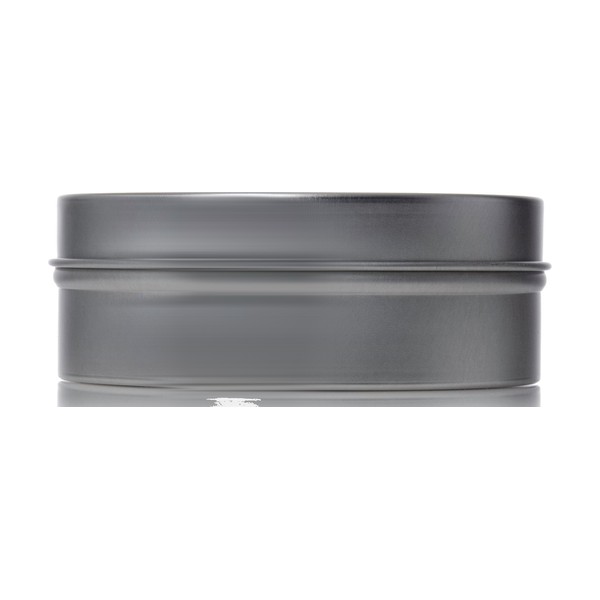
The problem with infrared on tins is emissivity, the measure of how well a surface radiates infrared energy. Fluke, a maker of test instruments, explains that shiny materials like polished metal have low emissivity and that low emissivity can make an infrared thermometer under-report the actual temperature [3]. Fluke gives unpainted metals an emissivity below 0.6 and says highly emissive surfaces are above 0.9 [4]. A bright tin can therefore read far cooler than it is, which is the dangerous direction for a safety check.
Fluke's fix is to put a piece of non-reflective tape, such as electrical tape, or flat paint on the surface before taking the reading, or to set the thermometer's emissivity to match the material [3]. For candle work, a small square of matte black electrical tape on the side of the tin or jar, at the spot you will measure every time, is the simplest way to make an infrared reading trustworthy. Check the tape's own temperature rating, and keep it well below the rim and away from the flame.
Also mind the spot size. Fluke explains that an infrared thermometer measures a circle that grows with distance; at a 12:1 distance-to-spot ratio, you are measuring a 1 inch circle from 12 inches away [3]. Hold the thermometer close enough that the spot falls entirely on the tape patch.
Where and when to measure
Kohl's does not publish where on the container its laboratory measures [1], so the method below is this page's practical approach. It is built to find the highest temperature, because that is the number a limit applies to.
- Mark your measuring points before the first burn. Use at least two: one on the side wall level with the top of the wax, and one lower down, about where the wax will be in the last sessions. On a multi-wick candle, add a point on the wall nearest each wick.
- Read at every hourly check. Record each point separately.
- Expect the reading to rise through a session. The highest reading of a 4 hour session usually comes late in it, when the pool is widest and deepest.
- Expect it to rise through the candle's life. As the wax level drops, the flame sits lower in the vessel and closer to the glass. Your last few sessions are the ones most likely to exceed a limit; measure them with extra care. CandleScience's test instructions burn to 1/4 inch (6 mm) of wax remaining [5], which takes you into that zone.
- Check the base too. Place the candle on a heat-resistant surface and, at the end of the last sessions, measure the bottom of the vessel or the surface just beside it.
- Record the minimum, maximum and average for each session, the way Kohl's laboratory reports them [1].
If any reading passes your limit, finish that reading, put the candle out with a snuffer, and let it cool where it stands. Do not move a candle while the wax is liquid [6].
What a hot jar tells you
A jar that runs hot is almost always telling you about the wick, the wick's position or the fill.
| What you find | Likely cause | What to do |
|---|---|---|
| Whole jar runs hot from the second hour on, flame tall, pool deep | Oversized wick | Test the next size down; Supplies for Candles lists a container that gets very hot as a sign to wick down [7] |
| One side much hotter than the other | Wick off center or leaning toward that wall | Check centering at the pour; see attaching and centering wicks |
| Hot only in the last sessions | End of use heating, flame close to the base | Confirm the wick tab and wax remaining; consider a lower fill or a different vessel; check the fill line |
| Multi-wick candle hotter than single-wick versions of the same jar | Flames heating each other and the wall | Revisit wick size and spacing; see when a candle needs two or three wicks |
| Tin reads cool by infrared but feels hot | Emissivity error; the tin is hotter than it reads | Re-measure on a tape patch or with a contact probe [3] |
Heat is also what cracks glass. CPSC has announced several recalls of candles whose jars cracked or broke during use, including about 2.2 million Target Threshold candles in 2023 [8] and about 1,140 Little Cow Company candles in 2026 [9]. Those notices do not give temperatures, but they show why a jar's behavior late in its life deserves a number in your records.
A hot jar during a test means stop and change something
If a vessel exceeds the limit you are testing to, that build has failed, however well it pools. When to change the wick size helps you decide what to change first, and cracked or broken candle jars covers what to do when glass has already failed.
References
- Kohl's, Private Brands Performance Claims Test Protocols 100, Protocol 100-Z: Candle (including freestanding, taper, tealight, votive, filled and novelty candles), revised February 2025 (current revision; candle limits unchanged from 100-Y, February 2023), read October 22, 2026. https://link.kohls.com/content/dam/klink/100-Z-CANDLE.pdf
- Doug Clauson, Increasing Candle Safety, ASTM Standardization News, March/April 2013 (posted July 26, 2016). https://www.astm.org/news/increasing-candle-safety-ma13
- Fluke, How to Get Great Results with an Infrared Thermometer, undated, read October 22, 2026. https://www.fluke.com/en-us/learn/blog/temperature/how-to-get-great-results-with-an-infrared-thermometer
- Fluke, Understanding the relevance of emissivity to temperature measurement, undated, read October 22, 2026. https://fluke.com/en-gb/learn/blog/thermal-imaging/what-you-need-to-know-about-emissivity-and-infrared-energy
- CandleScience, How to Conduct a Burn Test, undated, read October 22, 2026. https://candlescience.com/learning/how-to-conduct-a-burn-test/
- National Candle Association, Candle Safety Tips, modified August 12, 2025. https://candles.org/candle-safety/
- Supplies for Candles, The Complete Guide to Wick Testing: What Every Candle Maker Needs to Know, published February 26, 2026, modified September 2, 2026. https://www.suppliesforcandles.co.uk/the-complete-guide-to-wick-testing-what-every-candle-maker-needs-to-know/
- U.S. Consumer Product Safety Commission, Target Recalls 2.2 Million Threshold Candles Due to Laceration and Burn Hazards, recall 23-255, August 10, 2023. https://www.cpsc.gov/Recalls/2023/Target-Recalls-2-2-Million-Threshold-Candles-Due-to-Laceration-and-Burn-Hazards-Sold-Exclusively-at-Target
- U.S. Consumer Product Safety Commission, Little Cow Company Recalls 9 oz Candles in Glass Jars Due to Fire, Burn and Laceration Hazards, recall 26-241, February 5, 2026. https://www.cpsc.gov/Recalls/2026/Little-Cow-Company-Recalls-9-oz-Candles-in-Glass-Jars-Due-to-Fire-Burn-and-Laceration-Hazards