
Are bubbles in my jam a problem?
Updated
On this page6
It depends on whether they move. Bubbles that stay fixed in place inside a set jam are air that was trapped while you filled the jar, and they are a cosmetic flaw. Bubbles that rise, move when you tilt the jar, or keep appearing in a jar that has been sitting still are gas from spoilage. NCHFP's rule is short: "If bubbles are moving, do not use" [1]. This page shows you how to tell the two apart at the shelf, what to do with each, and how to fill the next batch so less air gets trapped.
Still bubbles or moving bubbles: checking the jar
Hold the jar upright at eye level, look, then tilt it slowly and look again. NCHFP's spoilage check starts the same way, by holding the jar at eye level and rotating it [2].
| Check | Trapped air (cosmetic) | Spoilage gas (discard) |
|---|---|---|
| When the bubbles appeared | Present since the jam set | Showed up later, or are increasing |
| When you tilt the jar | Stay locked in the gel | Rise or move [1][2] |
| Lid | Concave and firmly sealed [2] | May be loose, bulging or unsealed |
| Outside of the jar | Clean | Streaks of dried food running down from the rim [2] |
| On opening | Nothing unusual | Liquid spurts, or the jam fizzes [2] |
| Smell | Fruit | Yeasty, sour or alcohol-like [3] |
| Surface | Clean | Mold, white, blue, black or green [2] |
One sign from the right-hand column is enough. Moving bubbles with a perfect-looking lid still mean the jar is spoiling.
Why air gets trapped
NCHFP lists the causes of bubbles as air trapped in the hot jelly, and spoilage [1]. The air gets in three ways:
- Foam that was not skimmed. Boiling jam whips air into a foam on the surface. Ladled into the jar, it leaves a froth on top and bubbles through the jam [1].
- Slow filling. Every minute the jam stands in the pot, it cools toward its gel point. Once it starts to set, it holds whatever air the ladle puts in [1].
- Thick jam and fruit pieces. A heavy jam with chunks of fruit holds air pockets that a thin jelly would let rise.
What to do with each
Trapped air. Eat it, give it, keep it. If the jar was processed by a tested recipe, sealed properly and shows none of the spoilage signs, the bubbles change only how it looks.
Moving bubbles. Do not taste it, and do not open it to smell it if you can avoid it. NCHFP says not to taste food from a jar that shows signs of spoilage [2]. Put the jar in a heavy garbage bag, close the bag and put it in the trash [2], then check the rest of the batch. How to tell a jar has gone bad covers handling a leaking jar and cleaning up, and when a jar needs the stricter handling used for low-acid foods.
Filling so less air gets trapped
- Skim the foam off the jam as soon as you take it off the heat, before you start filling [1]. Foam: skim it or add butter? covers why it forms and why butter is not the answer for jam you sell.
- Have everything ready first. Hot jars, funnel, ladle and lids should be lined up before the jam reaches its final boil, so you can fill without a pause.
- Ladle quickly and do not let the jam begin to gel before the jars are full [1].
- Free trapped air. Run a clean nonmetallic tool, such as a plastic bubble remover or a chopstick, down the inside of the jar, the same step UC Master Food Preservers describe for canned fruit [4]. Check the headspace again afterward.
- Follow the recommended lid and processing method [1]. A good seal is what keeps a cosmetic bubble from becoming a spoilage problem.
A note on whole-fruit jams: UC Master Food Preservers suggest letting jam stand in the pot about 5 minutes and then stirring to keep fruit from floating [4]. That short rest helps fruit stay suspended; it does not mean letting the jam sit until it starts to set. Stir, then fill quickly. Jelly, which has no fruit to suspend, should go into jars as soon as it is ready. Floating, tough or shriveled fruit covers that trade-off.
When bubbles come with other warning signs
If you find moving bubbles, look for mold, a fermented smell or a failed seal in the rest of the batch, and work out why: mold and fermentation in jam traces the usual causes, from seal failure to underprocessing, and cooling jars and checking the seal shows how to catch a bad seal before a jar goes on the shelf.
Top picks
Top containers for jams and preserves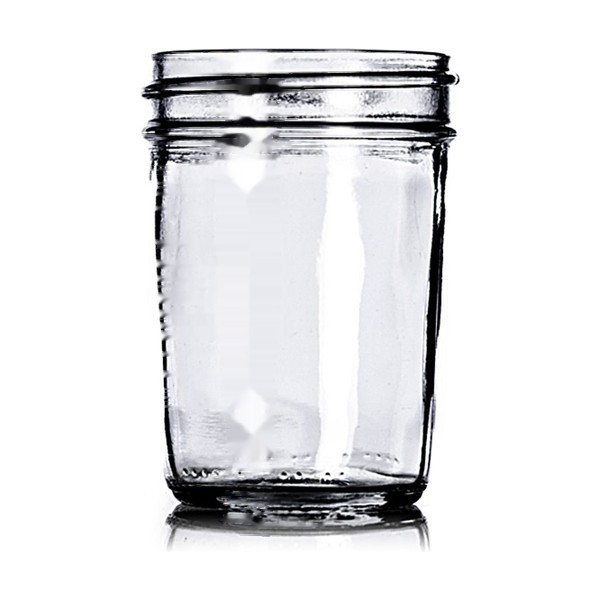 8 oz · 70-450G · Glass · 3.8 in
 8 oz · 58-400 · Glass
 12 oz · 70-450G · Glass
 16 oz · 70-450 · Glass
 32 oz · 70-450G · Glass
 8 oz · 70-450G · Glass · 3.5 in
 12 oz · 63-400 · Glass
 16 oz · 70-450G · Glass
References
- National Center for Home Food Preservation, *Causes and Possible Solutions for Problems with Jellied Fruit Products*, adapted from *So Easy to Preserve*, 6th ed., 2014 (accessed October 2026). https://nchfp.uga.edu/how/make-jam-jelly/jams-jellies-general-information/causes-and-possible-solutions-for-problems-with-jellied-fruit-products/
- National Center for Home Food Preservation, *Identifying and Handling Spoiled Canned Food*, adapted from USDA, *Complete Guide to Home Canning*, rev. 2015 (accessed October 2026). https://nchfp.uga.edu/how/can/general-information/identifying-and-handling-spoiled-canned-food/
- National Center for Home Food Preservation, *Storing Home Canned Jams and Jellies*, October 2005. https://nchfp.uga.edu/how/make-jam-jelly/jams-jellies-general-information/storing-home-canned-jams-and-jellies/
- UC Master Food Preservers of El Dorado County, UC Cooperative Extension, *Preserve It: Canning Basics* (fruit float), May 2025. https://ccfruitandnuts.ucanr.edu/sites/default/files/2025-05/FSB-Fruit%20Float.pdf