
Can I sell jam in squeeze bottles or mini jars?
Updated
On this page5
Mini jars, yes; squeeze bottles, not from a home or cottage kitchen. A 4 ounce canning jar is covered by the half-pint processing time in a tested recipe, so it is a normal home-canned product [1][2]. Plastic squeeze bottles and single-serve cups have no tested home canning process, because every tested method for shelf-stable jam uses glass canning jars with two-piece lids [3]. Jam in a squeeze bottle is a commercial product: it needs a process designed for that container, usually by a process authority or a copacker, in a licensed facility. This page explains both, plus the options for cafes that want single portions.
Mini jars: the processing rule
Small jars are where many makers start selling: samplers, wedding favors, gift sets and hotel amenities. The rule for processing them is simple and agreed across extension sources.
- 4 ounce jars take the half-pint time. Kansas State University says 4 oz jam and jelly jars work well and should be treated like half-pints [1]. UC Master Food Preservers say the same: smaller jars can be used safely when processed for the same time as the next largest size, so 4 oz jars follow the 8 oz time [2].
- The general rule is "next size up." The National Center for Home Food Preservation's advice is to "use the process time for the next size larger jar than you have" [4].
- Altitude still applies. The half-pint time you borrow is the one for your elevation, from the same source as your recipe. Both published systems are laid out on how long to process jam.
Jars smaller than 4 ounces
Very small jars, such as 1.5, 2 or 3 ounce sizes sold for favors, follow the same logic: process them for the half-pint time. Two practical problems come with them:
- Overcooking. NCHFP warns that putting a much smaller jar through a larger jar's process risks "a very overcooked product" [4]. Soft-set and low-pectin jams can firm up or darken in tiny jars. Sterilizing the jars first so you can use the shorter sterilized-jar time, where your recipe allows it, reduces the heat; see do you need to sterilize jars?.
- Lids and canning racks. Not every tiny jar is a canning jar, and not every decorative mini jar comes with a two-piece canning lid. Use only jars sold for home canning with the matching lids, and use a rack or a folded towel so small jars do not tip and float in the canner.
Labeling small jars
A small jar still needs every required label element. On a jar whose front panel is 5 square inches or less, the net weight figures can be as small as 1/16 inch and need not sit in the bottom 30 percent of the panel [5]. The other elements still have to fit and be legible at 1/16 inch [6]. On a favor jar that often means a front label with the name and net weight and a wrap or lid label for the rest. Weigh your fills for each small size; your half-pint figure does not scale down neatly. The method is on jar sizes and fill weights.
Squeeze bottles: why they are a commercial product
Squeeze bottles are tempting: they are cheap, light, unbreakable and popular with buyers of honey and syrups. For shelf-stable jam they are a different matter.
There is no tested home process. USDA's jam and jelly instructions specify mason jars with self-sealing two-piece lids processed in boiling water [3]. Tested home methods were developed in those containers, and a processing time does not transfer to a container it was not tested in. A plastic bottle heats differently, may not tolerate a boiling water canner, and has no self-sealing lid to show a vacuum.
Plastic belongs in the freezer and refrigerator. Extension guidance does allow plastic freezer containers for freezer jam, which is never heat-processed and is kept frozen or refrigerated [7]. A squeeze bottle of freezer jam or refrigerator jam is a reasonable thing to make for your own kitchen. It is not a shelf-stable product for sale.
Most cottage rules point to glass. Michigan's cottage food list, for example, allows fruit jams and jellies in glass jars stored at room temperature [8]. Where a state is silent, its program will still expect the tested method, which means a canning jar.
Commercially, it can be done, with the right process. Penn State's commercial primer tells producers to follow extension methods exactly, including the container size and processing method, and describes commercial hot-fill and hot-fill-hold processes with specific fill temperatures [9]. A squeeze format needs a process designed and documented for that exact product and bottle, including whether the bottle and closure can take the fill temperature. That design comes from a process authority, and the filling is usually done in a licensed facility or by a copacker. See process authorities and scheduled processes and working with a copacker.
There is also a product problem: a jam with fruit pieces will not flow through a squeeze tip. Squeeze products are usually smooth, thinner spreads or syrups, which brings naming into play; see what you can call your jam.
Single-serve portions for cafes and gift sets
Cafes, bed and breakfasts and caterers sometimes ask for jam in single portions. The options, from simplest to hardest:
| Format | How it works | Who can make it |
|---|---|---|
| Your half-pints or pints, served by the cafe in its own ramekins | The cafe opens a jar and portions it under its food service rules | You sell jars; the cafe handles portions under its own permit |
| 2 to 4 ounce canning jars | Small canning jars processed at the half-pint time | Home and cottage producers where the state allows the product [1][2] |
| Portion cups with peel-off lids | Plastic cups heat-sealed with foil or film lids | Commercial processors with sealing equipment and an approved process |
| Squeeze packets or sachets | Form-fill-seal packaging | Commercial copackers |
For most small makers, the first two rows are the answer. Before you offer the first one, check whether your state allows cottage sales to a business at all; many do not. That question is covered on selling jam to shops and cafes.
For gift sets, mini jars are the natural format. Three or four 4 ounce jars in a box make a better gift than a single pint, and each jar carries the half-pint processing time you already use. Presentation ideas are on gift sets and shelf presentation.
Start with the jar sizes you can process
If small jars are your plan, the next step is weighing your fills and settling your declared weights on jar sizes and fill weights. If a squeeze bottle is the plan, start the conversation with a process authority before you buy bottles.
Top picks
Top containers for jams and preserves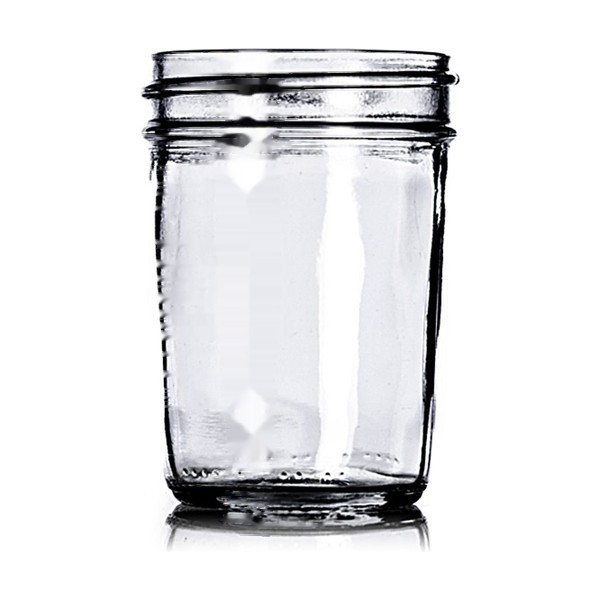 8 oz · 70-450G · Glass · 3.8 in
 8 oz · 58-400 · Glass
 12 oz · 70-450G · Glass
 16 oz · 70-450 · Glass
 32 oz · 70-450G · Glass
 8 oz · 70-450G · Glass · 3.5 in
 12 oz · 63-400 · Glass
 16 oz · 70-450G · Glass
References
- Kansas State University (K. Blakeslee), Choose the Right Jar, You Asked It!, September 13, 2019. https://www.k-state.edu/news/you-asked-it/articles/2019/09/choose-the-right-jar.html
- UC Master Food Preservers of El Dorado County, Preserve It: Canning Basics, Adjusting Canning Jar Sizes, July 2025. https://oc4h.ucanr.edu/sites/default/files/2021-11/360434.pdf
- U.S. Department of Agriculture, Complete Guide to Home Canning, Guide 7: Preparing and Canning Jams and Jellies, revised July 2015 (NCHFP copy). https://nchfp.uga.edu/papers/guide/GUIDE07_HomeCan_rev0715.pdf
- National Center for Home Food Preservation, Jar Size Choices Have You Frustrated?, October 8, 2019. https://nchfp.uga.edu/blog/jar-size-choices-have-you-frustrated
- eCFR, 21 CFR 101.7, Declaration of net quantity of contents, up to date as of October 20, 2026. https://www.ecfr.gov/current/title-21/chapter-I/subchapter-B/part-101/subpart-A/section-101.7
- eCFR, 21 CFR 101.2, Information panel of package form food, up to date as of October 20, 2026. https://www.ecfr.gov/current/title-21/chapter-I/subchapter-B/part-101/subpart-A/section-101.2
- N.C. Cooperative Extension, Sampson County Center (S. Knowles), Freezer Jam, June 13, 2022. https://sampson.ces.ncsu.edu/news/freezer-jam/
- Michigan Department of Agriculture and Rural Development, What Can I Make? (cottage food), not dated (viewed 2026). https://www.michigan.gov/mdard/food-dairy/cottage-food/what-can-i-make
- Penn State Extension (L. LaBorde), Food for Profit: Commercial Production of Jams, Jellies, and Fruit Butters, updated May 24, 2024. https://extension.psu.edu/food-for-profit-commercial-production-of-jams-jellies-and-fruit-butters