Can I bottle hot sauce without heating it?
Updated
On this page10
For a sauce you sell, only if a process authority sets a cold-fill process for that formula. Research does support it for one kind of sauce: Breidt, Sandeep and Arritt (2010) found that acidified foods with acetic acid (vinegar) as the main acid and a pH below 3.3 need no heat step, provided the filled product is held long enough for acid to kill pathogens: 48 hours at 77°F (25°C) or six days at 50°F (10°C) [1]. Treat it as published research to take to a process authority; on its own it does not give you a process. For a sauce you make at home and do not heat or can, the answer is the refrigerator. This page explains the research, the conditions behind it and what a process authority will want.
What the research found
Breidt and colleagues, at USDA-ARS and NC State, were modeling heat processes for acidified vegetables. Their paper sets out that acidified vegetables with a pH above 3.3 must be heat processed, and that products with acetic acid as the primary acid and a pH below 3.3 do not require a heat process but do require a holding time that depends on temperature [1]:
| Holding temperature | Holding time for a 5-log reduction [1] |
|---|---|
| 77°F (25°C) | 48 hours |
| 50°F (10°C) | 6 days |
A 5-log reduction is a 99.999 percent kill. The target organism is E. coli O157:H7, which the authors name as the most acid-resistant pathogen of concern, with an infectious dose possibly as low as one to ten cells [1]. The holding times trace to measured kill data in acidified cucumbers. The paper does not use the term "cold fill"; it is the research that cold-fill processes for very acidic products lean on.
Every condition has to hold
The finding applies only when all of these are true. If any one fails, the numbers above do not apply to your sauce.
- [ ] Acetic acid is the main acid. The acid comes mostly from vinegar. Citrus juice, lactic acid from fermentation or other acids are not what the finding describes [1].
- [ ] The pH is below 3.3 throughout the product, at equilibrium, meaning after acid has moved into every bit of pepper and garlic. A reading taken minutes after mixing can be lower than where the sauce settles (see equilibrium pH).
- [ ] The product is held at a known temperature for the full time before it is shipped or sold, and the hold is recorded.
- [ ] A process authority has set the process for your formula and container [2]. For an acidified food, that process becomes your scheduled process and is filed with FDA (see FCE registration and process filing).
A typical vinegar hot sauce does not automatically sit below 3.3. The USDA's purchase specification for hot sauce, for example, sets a pH of 3.4 or below for its Type I sauce [3]; a sauce can meet that and still be above 3.3. The pH figures that matter for safety are on what pH hot sauce needs to be.
Why a colder hold takes longer
It is natural to think the fridge is the safer place to hold a cold-filled sauce. For the hold, it is the slower one. Acid kills pathogens faster when it is warmer: Breidt's figures are 48 hours at 77°F and six days at 50°F [1].
A 2025 University of Georgia thesis on cold-filled acidified mayonnaise sauces shows how strong that effect is. In a lab formulation with acetic acid, the time to a 5-log reduction of E. coli O157:H7 was 3.3 days at 25°C (77°F) and 99 days at 5°C (41°F); E. coli O157:H7 was the most acid-resistant organism overall [4]. Those are mayonnaise sauces at a higher pH than hot sauce, so the numbers do not transfer. The direction does: refrigerating a cold-filled product right away can leave pathogens alive far longer than the hold time assumes. Your process authority will tell you at what temperature to hold.
Research on hot pepper sauce itself
Breidt's figures come from acidified vegetables. A 2019 study in the Journal of Food Protection tested cold-filled model hot pepper sauces directly, at pH 3.2, 3.5 and 3.9, acidified with acetic or citric acid and stored at ambient temperature. According to its abstract, at pH 3.2 with acetic acid, E. coli O157:H7, Salmonella and Listeria monocytogenes fell by more than 5 logs within half an hour, and a spoilage yeast and a Lactobacillus taken from spoiled commercial sauces within 6 hours. With citric acid, the most tolerant pathogen needed at least 48 hours to reach the same kill [5]. The authors concluded that a cold-fill-hold process "may be a suitable alternative" for hot pepper sauces acidified to pH 3.2 or lower with acetic acid [5].
Two things follow. The acid matters as much as the pH, which is why the acetic acid condition above is not optional. And these are laboratory results on model sauces, read here from the abstract, so they do not give you a hold time for your sauce. Your process authority sets that.
Where the sources disagree
Kansas State's 2024 hot-fill bulletin mentions a shorter room-temperature storage period for products below pH 3.3 filled into plastic, attributed to unnamed research and without naming the acid [2]. This page follows Breidt, Sandeep and Arritt: their paper is peer reviewed, states its organism, acid and pH conditions, and draws its times from measured kill data, while the shorter figure has no stated basis and is shorter at a cooler temperature. Neither replaces the hold your process authority sets.
Cold fill and plastic bottles
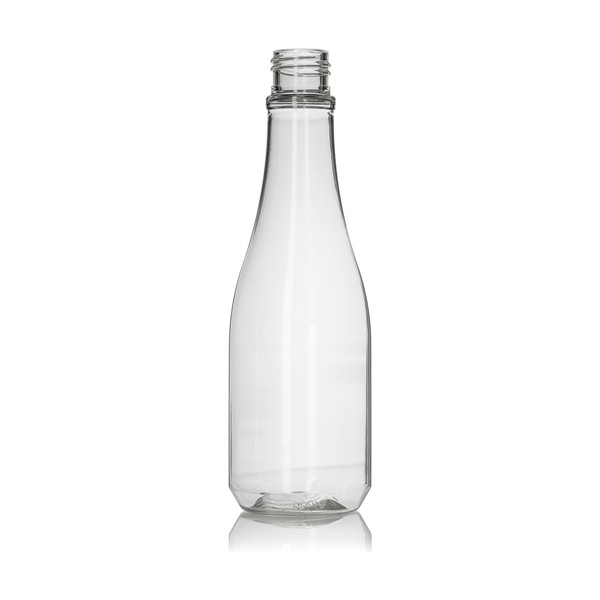
Cold fill comes up most often when a maker wants a plastic squeeze bottle that cannot take a hot fill. Kansas State lists the options for plastic containers: heat the sauce to the process authority's time and temperature and cool it before filling; if heating is not possible, lower the pH below 3.3 before filling; or add preservatives such as sodium benzoate or potassium sorbate, depending on the processing steps. Kansas State says all of these require process authority approval [2].
The first option is a heat process followed by a cold fill: the sauce is pasteurized in the kettle and filled cool. It protects the sauce, but the bottle and cap are not heated, so anything on them goes into the sauce. That is one reason processes like this often lean on preservatives or very low pH as well. The preservative route is on preservatives, and the bottle ratings on glass or plastic.
What a cold-fill hold does not cover
- Botulism. Acid controls Clostridium botulinum; the hold does not. The pH must stay at or below 4.6, and spores are not killed by these processes [1]. See botulism and hot sauce.
- Spoilage. The hold targets pathogens. Yeasts and molds that survive in a sauce that was never heated can still spoil it, which is why cold-filled products often use preservatives.
- Fermented sauces. A ferment finished with vinegar or another acid is treated in this book as an acidified food unless a process authority rules otherwise in writing. Whether its process can be a cold fill is that authority's call. The classification question is on is a fermented sauce an acidified food?.
Making uncooked sauce at home
If you blend a raw sauce or bottle a ferment without heating it, keep it in the refrigerator. That is not a cold-fill process; nobody has measured its pH at equilibrium or validated a hold, and at home you have no way to confirm the conditions above. Fridge storage keeps it safe and slows spoilage. See does hot sauce need to be refrigerated?.
Taking a cold-fill idea to a process authority
If you want to sell a sauce without heating it, the next step is a process authority who handles acidified foods, with your formula by weight, its acid source and a measured pH. How to choose one, and which accept fermented products, is on finding a process authority.
References
- F. Breidt, K. P. Sandeep and F. M. Arritt, "Use of Linear Models for Thermal Processing of Acidified Foods," Food Protection Trends 30(5):268-272, May 2010 (copy hosted by UGA Extension). https://site.extension.uga.edu/foodscienceandtechnology/files/2023/07/Breidt-et-al-2010-Below-4.1.pdf
- Kansas State University Research and Extension (K. Getty and R. Gaikwad), Hot-Fill-Hold Process for Acid and Acidified Foods, MF3671, September 2024. https://bookstore.ksre.ksu.edu/download/hot-fill-hold-process-for-acid-and-acidified-foods_MF3671
- USDA Agricultural Marketing Service, Commercial Item Description A-A-20097G, Hot Sauce, July 12, 2019. https://www.ams.usda.gov/sites/default/files/media/AA20097GHotSauce.pdf
- P. Kotkar, Microbial Inactivation in Cold-Filled Acidified Mayonnaise Sauces, MS thesis, University of Georgia, 2025. https://openscholar.uga.edu/record/27359/files/Kotkar_uga_0077N_16625.pdf
- A. Lobo Chinchilla, C. Zúñiga Arrieta, R. W. Worobo, O. I. Padilla Zakour and J. Usaga Barrientos, "Fate of Spoilage and Pathogenic Microorganisms in Acidified Cold-Filled Hot Pepper Sauces," Journal of Food Protection 82(10):1736-1743, 2019 (abstract, University of Costa Rica repository). https://www.kerwa.ucr.ac.cr/items/d13ae886-62d0-4f48-81b7-b7b8377dd160/full